
Endpoint Power Management Software Enterprise
Modern enterprises are leaving significant energy savings on the table. Discover how PowerPlug’s AI-powered platform turns idle PCs into a strategic cost and carbon reduction lever — at scale, without disrupting users.
Enterprise IT departments manage thousands — sometimes hundreds of thousands — of PCs. Most of those machines sit idle for the majority of the working day, consuming electricity around the clock. Traditional power policies are static, blunt, and frequently ignored by users. AI-driven PC power management changes the equation entirely, applying machine-learning logic to real usage patterns so that energy is saved precisely when it can be, and never at the cost of user experience.
Key Takeaways
- Static power policies fail at enterprise scale — AI adapts to real user behaviour in real time.
- PC endpoints are a substantial, often overlooked, share of an organisation’s total IT energy footprint.
- Intelligent sleep and wake scheduling eliminates unnecessary idle consumption without user friction.
- Centralised reporting gives sustainability and finance teams the data they need to evidence ROI.
- AI-driven power management integrates with existing IT infrastructure and requires no new hardware.
- Carbon reduction targets and corporate ESG commitments are directly supported by measurable endpoint savings.
Article Navigation Table of Contents
- The PC Power Problem in the Enterprise
- Why Traditional Power Policies Fall Short
- How AI Transforms Power Management
- Core Capabilities of an AI-Driven Platform
- Energy Savings: The Numbers That Matter
- Supporting ESG and Carbon Reduction Goals
- Integration and Deployment Considerations
- Building the Business Case
- Frequently Asked Questions
The PC Power Problem in the Enterprise
Enterprise fleets of desktop and laptop computers represent a deceptively large share of total organisational energy consumption. In a typical large organisation, PCs and monitors can account for 20–40% of IT energy use — and that figure climbs when you account for the hours those machines spend powered on but completely idle.
The core issue is straightforward: corporate PCs are rarely switched off at the end of the day. IT security policies, overnight patching windows, and simple employee habit conspire to keep endpoints running continuously. A machine that is awake and active for just six hours of genuine productive use but powered on for twenty-four is wasting more than three-quarters of the electricity it consumes.
Scale Amplifies the Problem
For an organisation with 5,000 PCs, even a modest reduction in idle energy draw translates into hundreds of thousands of kilowatt-hours saved annually. Multiply that across a global enterprise and the potential becomes substantial — both financially and in terms of carbon emissions. Yet many IT teams treat endpoint power as a low-priority operational footnote rather than a strategic efficiency lever.
The Hidden Cost of Always-On Endpoints
Beyond electricity spend, always-on endpoints carry secondary costs: increased hardware wear, higher cooling loads in office environments, and a measurable contribution to an organisation’s Scope 2 carbon emissions. As energy prices remain elevated and regulatory pressure around corporate carbon reporting intensifies, the business case for addressing this problem has never been stronger.
Why Traditional Power Policies Fall Short
Most organisations have attempted to address PC energy waste through native operating system power settings — Windows power plans, Group Policy Objects, or basic SCCM scripts. These approaches share a common flaw: they are static. They apply the same rules to every machine, every user, and every time of day, regardless of actual usage context.
The One-Size-Fits-All Failure
A developer running overnight builds needs a completely different power profile from a finance analyst who leaves their machine idle from 5pm until 9am. A call-centre agent with a predictable eight-hour shift has different requirements from a travelling salesperson whose usage pattern is highly irregular. Static group policies cannot distinguish between these scenarios, so IT teams are forced to choose between being too aggressive (causing user complaints and disrupted workflows) or too conservative (saving little energy at all).
User Override and Policy Drift
Even well-designed static policies erode over time. Users override settings when they experience disruption — a presentation interrupted by sleep, a download cancelled by shutdown. IT administrators create exceptions that multiply until the policy is effectively moot for a significant portion of the fleet. Compliance monitoring for power settings is rarely prioritised, so drift goes undetected.
Lack of Visibility
Traditional approaches provide little to no reporting on actual endpoint power states, consumption patterns, or savings achieved. Without data, it is impossible to demonstrate value to finance or sustainability stakeholders, identify outliers, or continuously improve the approach. Power management becomes a set-and-forget task rather than a managed programme.
| Approach | Adaptability | User Impact Risk | Reporting | Scalability |
|---|---|---|---|---|
| Native OS Power Plans | None — static rules | High — blunt thresholds | Minimal | Limited |
| Group Policy / SCCM Scripts | Low — manual updates required | Moderate — exception creep | Minimal | Moderate |
| AI-Driven Platform (e.g. PowerPlug) | High — learns usage patterns | Very Low — user-aware scheduling | Comprehensive | Enterprise-grade |
How AI Transforms Power Management
The fundamental advantage of an AI-driven approach is the ability to make context-aware decisions at machine level, continuously. Rather than applying a uniform rule, the platform learns the unique usage signature of each endpoint and uses that intelligence to determine precisely when it is safe — and optimal — to apply a power-saving action.
Machine-Level Usage Learning
AI models analyse data points including login and logout times, application activity, network interaction, peripheral usage, and historical patterns for each individual PC. Over time, the system builds a behavioural profile for every endpoint, enabling it to predict with high confidence when a machine is genuinely idle versus temporarily inactive — for example, during a meeting or a focused thinking task that generates no keyboard or mouse input.
Predictive Sleep and Wake Scheduling
Rather than reacting to idle timeouts, an AI-driven platform can proactively schedule power-down events based on predicted usage windows. If a machine’s historical data shows that a particular user never resumes work after 6:30pm on Fridays, the system can schedule shutdown at that time — well before a static timeout would trigger. Equally, it can pre-wake machines in advance of predicted start times, so users arrive to a ready desktop rather than a boot sequence.
Dynamic Policy Adjustment
As usage patterns evolve — new projects, seasonal variation, hybrid working shifts — the AI model adapts without requiring manual IT intervention. Policy effectiveness is maintained automatically, eliminating the drift that undermines static approaches.
Protecting User Productivity
Critically, the AI understands context sufficiently to avoid disruptive actions. If a machine is running an active process — a large file transfer, a software update, a scheduled task — the system will delay or bypass the power-saving action. User experience is preserved, which in turn protects IT team credibility and prevents the override behaviour that undermines traditional policies.
See AI Power Management in Action
PowerPlug’s platform is purpose-built for enterprise endpoint fleets. Discover how intelligent scheduling and real-time analytics can cut your PC energy costs — without a single user complaint.
Core Capabilities of an AI-Driven Power Management Platform
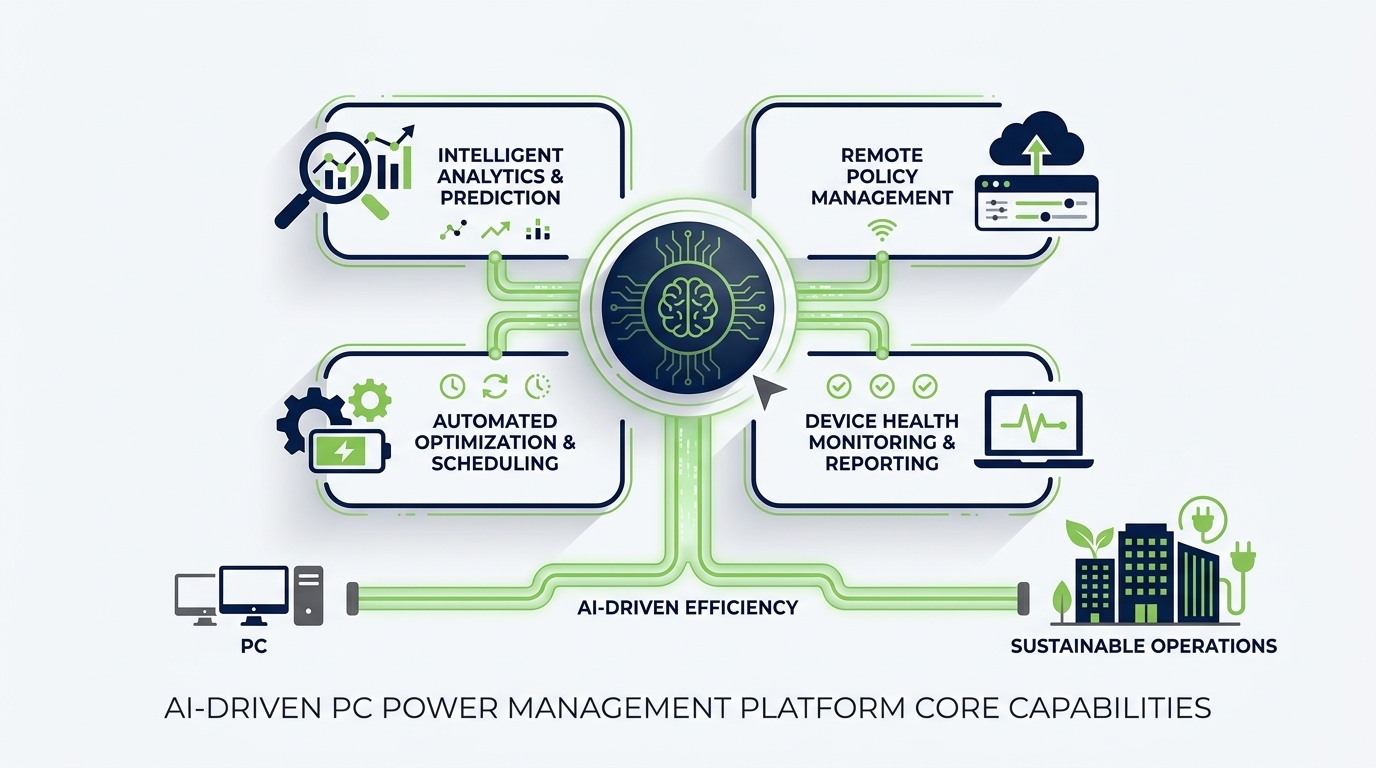
Effective enterprise power management requires more than a smart scheduler. A fully capable platform delivers a suite of integrated capabilities that together enable sustained, measurable, and manageable energy reduction across the entire endpoint estate.
Centralised Policy Management
IT administrators manage power policies for the entire fleet from a single console. Policies can be applied at fleet, group, or individual machine level, with the AI layer adapting behaviour within the parameters set by the IT team. This preserves IT control while enabling machine-level intelligence.
Real-Time Power State Monitoring
Live dashboards show the current power state of every endpoint in the estate — on, idle, sleep, off — and aggregate this into fleet-level views. IT managers can immediately identify machines that are non-compliant with power policies or consuming energy unexpectedly.
Energy and Carbon Reporting
Detailed reporting translates power state data into energy consumption figures (kWh) and associated carbon emissions (CO₂e). These reports are structured to support sustainability reporting frameworks and to provide the financial data needed to quantify ROI. Scheduled automated reports can be delivered directly to stakeholders.
Wake-on-LAN Integration
Enterprise power management must accommodate legitimate out-of-hours IT operations — patch deployments, software distribution, backup jobs. AI-driven platforms integrate with Wake-on-LAN capabilities to bring machines online precisely when needed for these tasks, then return them to a low-power state on completion.
User and Helpdesk Interfaces
Self-service tools allow users to temporarily adjust their own power settings within IT-defined boundaries — for example, to prevent sleep during a long presentation or video call. This reduces helpdesk friction and user-driven workarounds, while keeping the IT team in control of policy boundaries.
Integration with IT Ecosystem
Enterprise-ready platforms integrate with directory services (Active Directory, Azure AD), endpoint management platforms (SCCM, Intune), and ITSM tools. This ensures power management operates within — and complements — the existing IT management framework rather than creating a parallel silo.
Energy Savings: The Numbers That Matter
The commercial case for AI-driven PC power management rests on concrete, measurable outcomes. Understanding the order of magnitude of potential savings helps organisations size the opportunity before committing to a formal business case.
Consumption Baseline
A typical desktop PC with monitor consumes in the range of 100–250 watts when fully active, dropping to 3–15 watts in a compliant sleep state and near zero when powered off. The energy wasted during idle-but-active periods is substantial: a machine drawing 150 watts for twelve unnecessary hours per day consumes approximately 657 kWh per year in wasted energy alone.
Fleet-Level Impact
Across a fleet of 5,000 machines, achieving even a conservative 30% reduction in per-machine annual consumption can deliver savings of several hundred thousand kWh per year. At current commercial electricity tariff rates in major markets, this translates into material cost savings — and a proportional reduction in associated carbon emissions.
Carbon Reduction
Every kilowatt-hour of electricity reduced represents a corresponding reduction in Scope 2 carbon emissions. For organisations with net-zero or carbon reduction commitments, PC power management offers a practical, rapidly deployable mechanism to evidence progress — particularly valuable because the savings are quantifiable, attributable, and auditable.
Payback and ROI
AI-driven power management platforms typically require no new hardware investment. Software deployment across an existing endpoint estate means that energy cost savings begin to accrue quickly after implementation. For most enterprise deployments, the cost of the platform is recovered within the first year of operation through energy savings alone, with ongoing net positive returns thereafter.
Supporting ESG and Carbon Reduction Goals
Environmental, Social and Governance (ESG) reporting has moved from voluntary best practice to a strategic business requirement. Investors, regulators, customers, and employees increasingly scrutinise corporate sustainability performance. For IT leaders, this creates both an obligation and an opportunity: endpoint power management is one of the few IT-delivered sustainability initiatives that produces quantified, reportable carbon savings within months of deployment.
Scope 2 Emissions Reduction
Corporate PC estates contribute to Scope 2 emissions — indirect emissions from purchased electricity. Reducing PC energy consumption directly reduces the Scope 2 footprint, and the savings can be measured, documented, and reported with precision. This auditability is critical for frameworks such as GHG Protocol reporting, CDP disclosures, and emerging mandatory climate reporting requirements in multiple jurisdictions.
Alignment with Corporate Net-Zero Commitments
Many organisations have made public net-zero or carbon neutrality commitments with specific target years. Meeting these commitments requires action across all material emission sources. PC power management provides a mechanism to make measurable progress on Scope 2 that is under direct IT and operational control — without dependency on external factors such as grid decarbonisation timelines.
Reporting and Stakeholder Communication
Comprehensive reporting from an AI-driven power management platform provides the data infrastructure needed to support ESG disclosures. Carbon savings figures, energy consumption trends, and fleet compliance rates can be extracted in formats suitable for sustainability reports, board-level briefings, and regulatory filings. This transforms a technical IT programme into a boardroom-relevant sustainability story.
Integration and Deployment Considerations
For enterprise IT teams, any new platform must integrate cleanly with existing infrastructure, impose minimal operational overhead, and demonstrate a clear deployment path. AI-driven power management platforms designed for enterprise environments address these concerns directly.
Deployment Architecture
Lightweight agents are deployed to endpoint machines via existing software distribution mechanisms — SCCM, Intune, or similar tools. The management console is typically hosted in the cloud or on-premises depending on organisational security requirements. No new network hardware is required, and the agent footprint is designed to be non-intrusive to endpoint performance.
Directory and Identity Integration
Integration with Active Directory and Azure Active Directory enables policy assignment based on existing organisational unit structures, security groups, and user attributes. This means power policies can be aligned with business units, roles, locations, or any other organisational dimension that the IT team manages through the directory.
Compatibility with Patch and Update Workflows
A common concern when introducing aggressive power management is interference with overnight patch windows. AI-driven platforms are designed to co-exist with — and actively support — these workflows, using Wake-on-LAN to bring machines online for patching and returning them to a low-power state on completion. This eliminates the traditional conflict between energy saving and maintenance operations.
Security Considerations
Enterprise security teams will want assurance that the power management platform does not introduce new attack surface or data exposure risk. Reputable platforms operate with minimal data collection (power state telemetry rather than user content), encrypt all communications, and operate within the existing enterprise security perimeter. Security review documentation and penetration testing results should be available from the vendor for due diligence purposes.
Change Management and User Communication
Successful deployment is as much an organisational challenge as a technical one. Communicating the purpose of the programme to employees — framing it around sustainability goals and providing reassurance that productivity will not be impacted — significantly reduces resistance and override behaviour. Organisations that invest in clear user communication typically achieve better compliance and better savings outcomes.
Building the Business Case
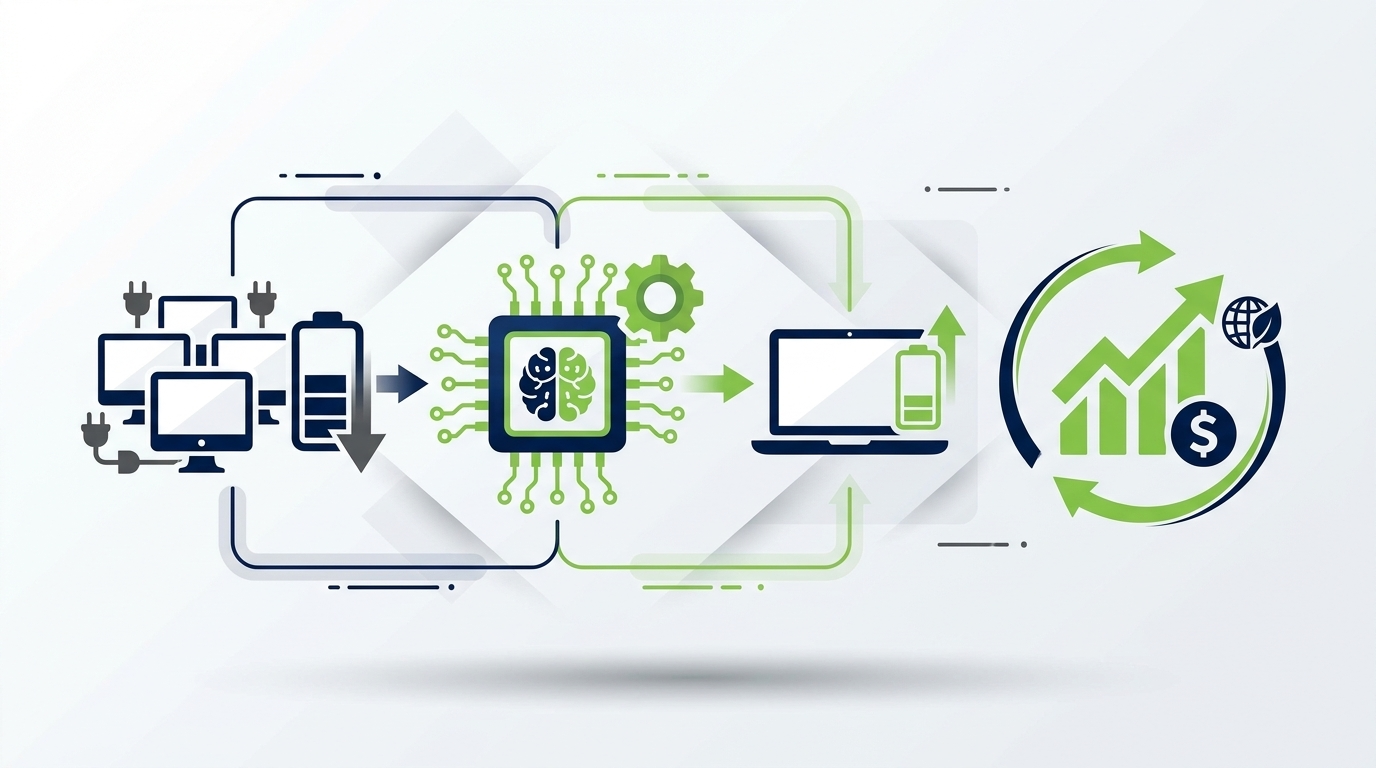
Securing investment in a power management programme requires a structured business case that speaks to both financial and strategic stakeholders. The good news is that the ROI case is relatively straightforward to construct, because the inputs — energy consumption, tariff rates, fleet size — are generally available, and the savings are measurable post-implementation.
Quantifying the Opportunity
- Establish baseline: total endpoints, estimated average active power draw, hours powered on outside productive use.
- Apply reduction assumption: conservative (20%), moderate (35%), or optimistic (50%+) based on fleet characteristics.
- Calculate energy saved: baseline consumption × reduction percentage = kWh saved annually.
- Apply tariff rate: kWh saved × electricity unit cost = annual cost saving.
- Calculate carbon reduction: kWh saved × grid emission factor = CO₂e reduced annually.
- Compare against platform cost: payback period and multi-year ROI.
Beyond Energy: Co-Benefits
A strong business case also captures co-benefits that extend beyond direct energy savings. Reduced hardware wear from fewer powered-on hours can extend device lifespans. Lower cooling loads in offices reduce HVAC energy consumption. Improved compliance visibility reduces audit risk. Carbon savings contribute to ESG commitments that have their own financial value through investor relations, customer requirements, and regulatory compliance.
Engaging the Right Stakeholders
The business case for PC power management spans multiple stakeholder groups. IT leadership cares about operational efficiency and compliance. Finance cares about cost reduction and ROI. Sustainability teams care about carbon metrics and ESG reporting. Procurement cares about vendor risk and contract terms. A well-structured business case addresses each of these perspectives and frames the programme as an enterprise-wide win rather than a purely technical IT initiative.
Ready to Unlock Your Enterprise PC Energy Savings?
PowerPlug works with enterprise IT and sustainability teams to design, deploy, and measure AI-driven power management programmes across large endpoint estates. Start a conversation with our team to understand what your fleet could save.
Frequently Asked Questions
Will AI-driven power management disrupt my users’ work?
A well-designed AI-driven platform is built specifically to protect user productivity. The AI learns individual usage patterns and avoids triggering power-saving actions when a machine is actively in use or running important background processes. Self-service controls allow users to temporarily override settings for specific scenarios such as presentations or long downloads, within boundaries set by the IT team.
How does the platform handle overnight patching and software deployment?
Enterprise power management platforms integrate with Wake-on-LAN to bring endpoints online precisely when needed for patch windows, software distribution, or backup operations. Once those tasks complete, machines are returned to a low-power state automatically. This eliminates the traditional conflict between energy saving and IT maintenance operations.
How long does it take to deploy across a large enterprise fleet?
Deployment timelines vary based on fleet size, infrastructure complexity, and the organisation’s existing endpoint management tooling. Lightweight agents are distributed via standard mechanisms such as SCCM or Intune, meaning the technical deployment can often be completed relatively quickly for large fleets. The platform vendor should provide a structured onboarding programme and dedicated implementation support.
How are savings measured and reported?
The platform continuously monitors the power state of every endpoint and translates this data into energy consumption figures (kWh) and associated carbon emissions (CO₂e). Dashboards and automated reports provide real-time and historical views of savings achieved, fleet compliance rates, and carbon reduction metrics. These reports are designed to support both internal stakeholder communication and external ESG disclosures.
What infrastructure or hardware changes are required?
AI-driven power management platforms are software-only solutions — no new hardware is required. Lightweight endpoint agents are deployed to existing machines, and the management console operates in the cloud or on-premises. The solution is designed to integrate with existing IT infrastructure including directory services, endpoint management platforms, and ITSM tools.
Can power management support our ESG and sustainability reporting?
Yes. One of the key advantages of a purpose-built enterprise power management platform is comprehensive reporting that translates energy savings into carbon reduction metrics. These reports are structured to support Scope 2 emissions reporting under frameworks such as GHG Protocol, and can be formatted for sustainability reports, board briefings, and regulatory filings. The savings are quantified, attributable, and auditable.
PowerPlug
PowerPlug is an enterprise PC power management platform powered by artificial intelligence. Deployed across large endpoint estates globally, PowerPlug helps IT and sustainability teams reduce PC energy consumption, cut carbon emissions, and evidence measurable ROI — without disrupting users or adding operational complexity. The platform integrates with existing IT infrastructure and provides comprehensive reporting for ESG and financial stakeholders.