Reading time: 10 minutes
You want to power machines down to save energy and still reach them for patching and support. Three technologies claim to help, and they are constantly confused for one another. Wake-on-LAN, Intel AMT, and IPMI all deal with a machine that is powered off, but they solve different problems, cost very different amounts, and belong on different kinds of hardware.
Choosing badly is expensive in both directions. Reach for the heavyweight option across a desktop fleet and you pay for capability you will never use. Try to stretch the lightweight option onto the machines that genuinely need full control and you come up short. This guide explains what each one actually is, compares them on the points that matter, and shows how to match the tool to the machine.
Three ways to reach a machine that is off
All three technologies exist because a normal remote-access tool cannot help a machine that is powered down. There is nothing running to connect to, so you need something that operates below the operating system. Where they differ is how much they do once they have reached the machine, and how much hardware and money that capability requires.
Wake-on-LAN does one thing, which is turn a machine on. Intel AMT and IPMI do that and a great deal more, offering console access and control that works even when the operating system is broken. That extra power is genuinely useful for some machines and pure overhead for others, which is the whole reason the choice matters.
What Wake-on-LAN is, and what it does
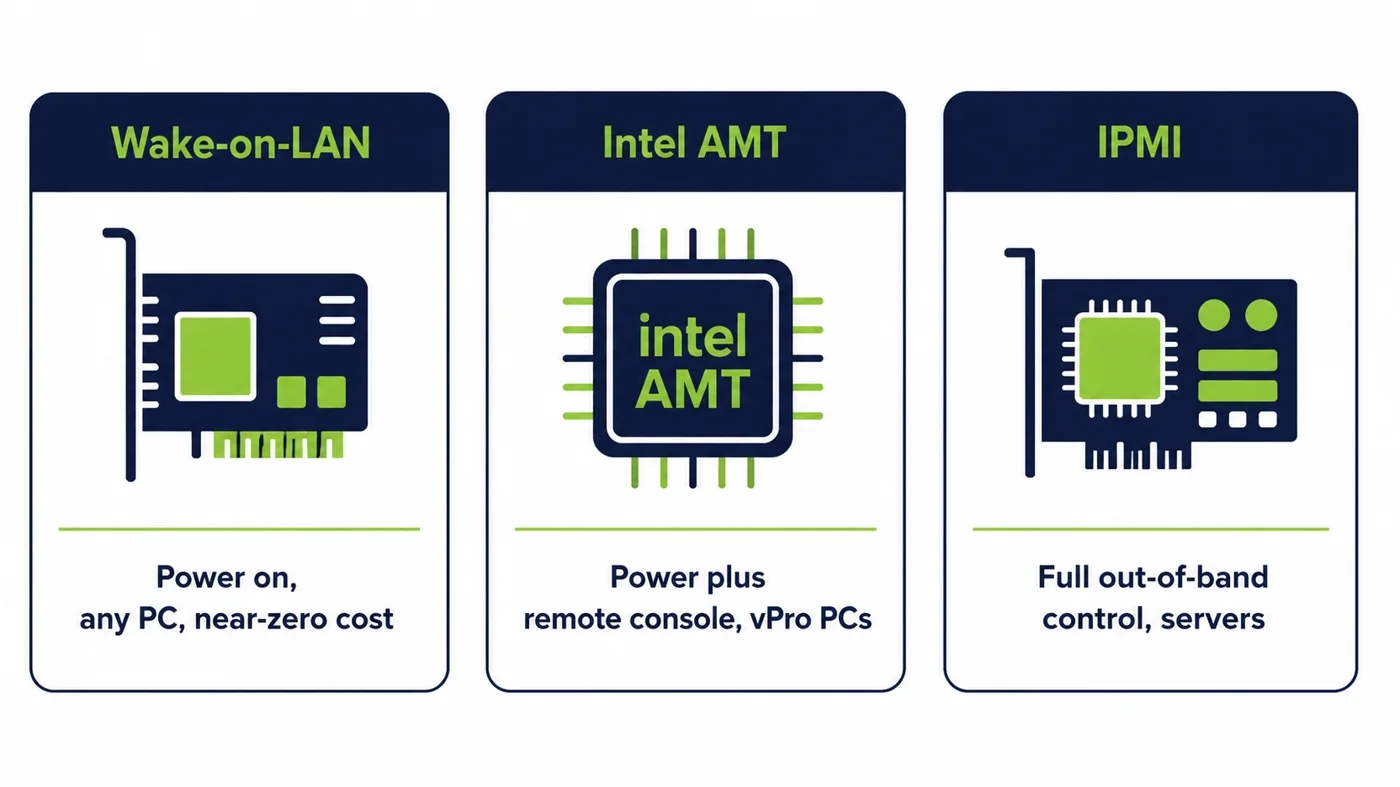
Wake-on-LAN is the lightweight option, and it is built into practically every network card already in your fleet. It listens for a specially formed wake packet while the rest of the machine is off, and when it sees its own address it tells the board to start. That is the entire feature, and its simplicity is exactly why it is the natural choice for a large fleet of ordinary desktops.
Because it needs no special chipset and no license, the cost of using it is effectively zero on hardware you already own. Its limitations are equally clear. It only turns a machine on, and the raw wake packet is local to a subnet, which means reaching machines across a segmented network takes some engineering. Neither limitation is fatal, and both are solvable.
What Intel AMT is, and where it fits
Intel AMT is out-of-band management built into business-class PCs with Intel vPro. It goes well beyond power-on, offering remote console, keyboard and screen access even when the operating system will not boot, and the ability to mount remote media for re-imaging. When a machine is genuinely broken rather than just asleep, that capability can save a desk visit.
The trade-offs are hardware and management. AMT only exists on vPro-capable machines, it has to be provisioned and maintained, and its own security has been the subject of serious advisories over the years, so it demands careful configuration. For the subset of machines that need deep remote control it is powerful, but as a way to simply wake a large desktop fleet it is far more than the job requires.
What IPMI is, and why it lives on servers
IPMI is the server world’s equivalent, a dedicated management controller on the motherboard, often branded as iDRAC, iLO, or similar. It gives operators full remote control of a server, including power, console, sensors, and re-installation, over a separate management network, independent of the main operating system. In a data center that level of control is not a luxury, it is a requirement.
But IPMI is a server technology. The dedicated controller adds cost and a management network, and desktops do not ship with it. Using IPMI to describe how you will wake office PCs is a category error, because the hardware simply is not there. It belongs on the servers it was designed for, not on the desktop estate.
The three, compared
Placing them in one table makes the fit obvious. The point is not that one wins, but that each suits a different machine.
| Factor | Wake-on-LAN | Intel AMT | IPMI |
|---|---|---|---|
| Best for | Large desktop fleets | vPro business PCs | Servers |
| What it does | Power on | Power plus remote console | Full out-of-band control |
| Hardware needed | Any standard network card | vPro-capable chipset | Dedicated controller |
| Cost per machine | Effectively zero | Higher, plus provisioning | Highest, server-class |
| Cross-subnet reach | Needs a relay design | Routable, managed | On its own network |
Power-on reliability, side by side
If all you need is to turn machines on reliably, all three can do it, but the reliability depends on setup rather than on the technology being fancier. AMT and IPMI have dedicated controllers that are always powered, which makes them dependable on the machines that have them. Wake-on-LAN depends on the network card staying in a listening state, which is dependable too as long as that state is maintained.
The practical failures of Wake-on-LAN are almost never the packet itself. They are a listening state switched off by a firmware update, or a wake request that could not cross a subnet boundary. Both are managed problems, not fundamental ones, which is why a well-run Wake-on-LAN deployment reaches the same reliability people assume only the expensive options can.
What each can do beyond power-on
This is where the technologies genuinely diverge. Wake-on-LAN turns a machine on and then steps aside, leaving you to connect with your normal remote tools once it has booted. AMT and IPMI keep going, offering a remote console that works before the operating system loads, the ability to fix a machine that will not boot, and remote media to re-image it.
The question is how often you actually need that. For the overwhelming majority of desktops, the answer is rarely, because when a working machine is simply off, a power-on is the entire requirement. The deep control matters for the machines that break in ways a reboot cannot fix, which is a small fraction of most estates.
Hardware, licensing, and hidden costs
The sticker price is only part of the cost. Wake-on-LAN rides on hardware you already own, so its real cost is the effort to deploy and manage it well. AMT requires vPro machines and a provisioning and maintenance process, and IPMI requires server-class controllers and a separate management network. Both of the heavier options carry an ongoing operational cost that is easy to underestimate at procurement.
The trap is buying deep management capability across a whole desktop fleet to solve what is really just a power-on problem. You end up paying, per machine and per year, for console features that a desktop will almost never use, when a well-run Wake-on-LAN deployment would have met the need for a fraction of the cost.
The security profile of each
More capability means more attack surface, and the heavier options carry more of it. AMT and IPMI are powerful management planes that sit below the operating system, and precisely because they can do so much, a weakness in them is serious. Both have had notable security advisories, and both require disciplined configuration and patching to stay safe.
Wake-on-LAN, done securely, has a smaller footprint because it does less. It can only start a machine, and when the wake is authenticated and kept local to its segment there is very little for an attacker to exploit. Doing less turns out to be a security advantage when less is all you need.
Reaching machines across subnets
The most cited weakness of Wake-on-LAN is that its wake packet is local to a subnet, which sounds like a dealbreaker in a segmented enterprise. It is not, because a relay or agent placed inside each segment delivers the wake locally on command, so a central request reaches any machine without forwarding broadcast across the network.
This is exactly what a managed platform provides. PowerPlug’s Wake-Up technology coordinates that cross-segment reach, which is why Wake-on-LAN can be relied on across a real corporate network rather than only on a flat one. The subnet limitation is a solved problem, not an inherent ceiling.
Why Wake-on-LAN fails in real networks
When people say Wake-on-LAN is unreliable, they are usually describing an unmanaged deployment. The two recurring failures are a network card that stopped listening after an update, and a wake request that could not cross a subnet. Both make the technology look worse than it is, and both disappear under proper management.
A platform that holds the endpoint listening state in place, delivers the wake locally in every segment, and confirms the machine actually came up turns Wake-on-LAN from a hopeful broadcast into a dependable operation. The failures are operational, so they respond to operational fixes, which is what separates a working deployment from a frustrating one.
Scheduled wake-ups for patching at scale
The everyday reason enterprises want reliable remote power is patching. Update cycles run in maintenance windows, and if the machines are off, the patches miss them and compliance slips. A scheduled wake brings the fleet up ahead of the window, the updates run, and the machines can go back to sleep, all without anyone leaving a PC on overnight for the sake of it.
Wake-on-LAN is well suited to this because it scales cheaply across thousands of machines. Where AMT or IPMI would each add cost per endpoint, a managed Wake-on-LAN deployment brings a whole desktop estate up on schedule at effectively no per-machine premium, which is why it is the usual choice for fleet-wide patching.
Choosing for a fleet versus a server room
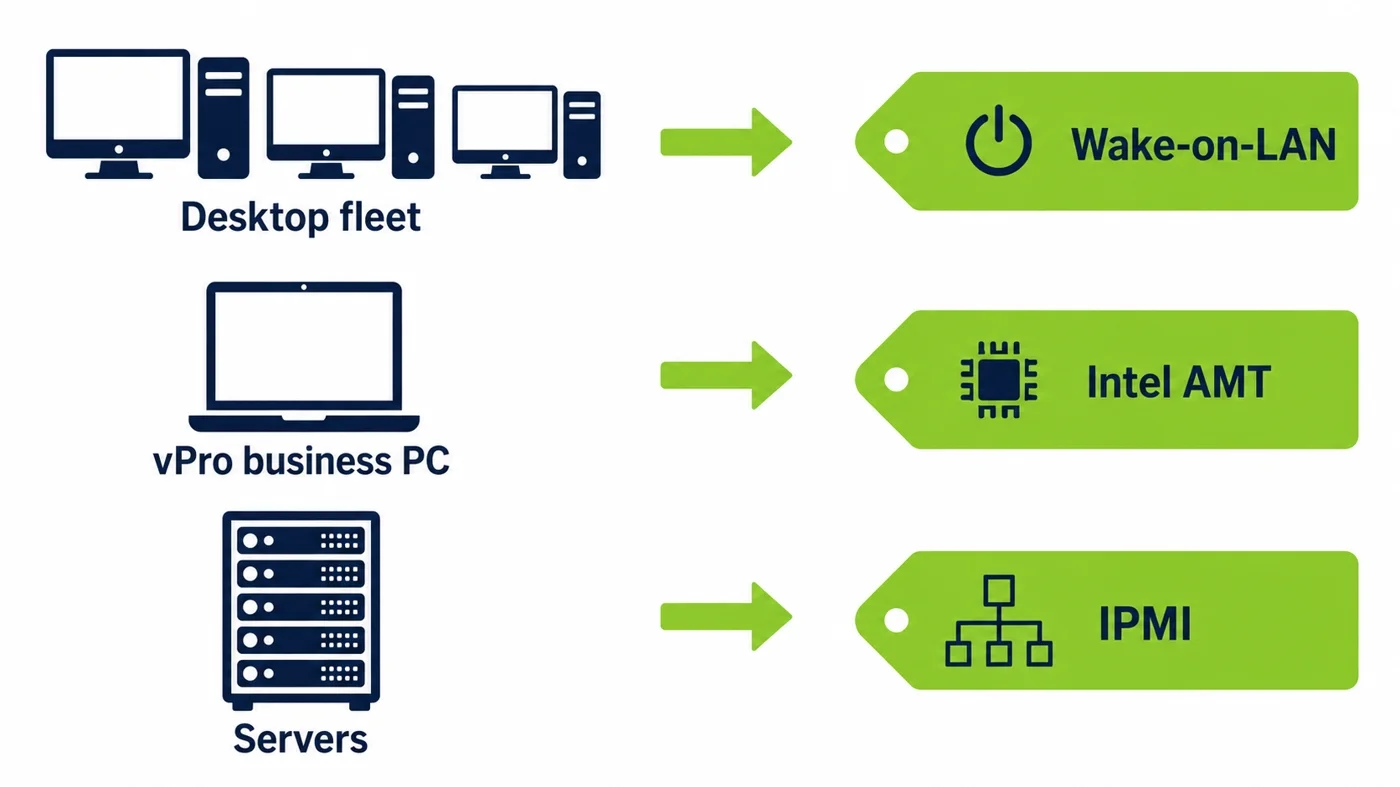
The decision becomes simple once you separate the estate by what it actually needs. For the large fleet of ordinary desktops and laptops, where the need is reliable power-on for patching and remote access, secure Wake-on-LAN is the right and economical choice. For the servers in the data center, IPMI is the expected tool and is already part of the hardware.
AMT sits in between, worth enabling on the specific vPro machines where a technician genuinely needs pre-boot console access, and not worth paying for across the whole fleet. Most organizations end up using more than one of these, matched to the machine, rather than forcing a single technology onto everything.
When Wake-on-LAN is not possible
There are edge cases where Wake-on-LAN does not fit, such as a machine whose network card genuinely cannot keep listening, or an environment where the endpoint cannot be managed to hold the required state. In those situations the out-of-band options earn their keep, because their dedicated controllers do not depend on the main hardware behaving.
These cases are the exception rather than the rule. For most modern fleets the network cards support Wake-on-LAN and can be managed to keep listening, so the alternatives are reserved for the specific machines where they are truly needed rather than adopted wholesale.
How this fits a hybrid-work and sustainability strategy
The reason any of this matters now is that organizations want to power idle machines down, both to cut cost and to meet sustainability goals, without stranding the people who work remotely. Reliable remote power is the enabler, because it lets machines sleep at night and still be there when a patch cycle or a remote worker needs them.
For that job at fleet scale, secure Wake-on-LAN is usually the most economical fit, and the idle-PC energy it lets you reclaim is the same waste the US ENERGY STAR program has documented for years. It sits at the center of PowerPlug’s enterprise Wake-on-LAN solution, and the wider platform is described on the platform overview.
What procurement should not miss
A comparison that stops at features misses the parts that hurt later. The first is total cost of ownership, not the headline price, because the heavier options carry provisioning, licensing, and a separate management network that only show up once the project is under way. The second is the security burden, since a powerful management plane is a powerful thing to secure and patch for the life of the fleet.
The third is reach across your actual network, because a technology that works on a flat lab network can still stumble across the VLANs and sites of a real enterprise. Ask how each option is managed at scale, how it is secured, and how it reaches every segment, and the right fit for each part of the estate becomes clear rather than being decided by a feature checklist alone.
Out-of-band management and remote access are different
It helps to keep two ideas separate that often get merged. Out-of-band management, which AMT and IPMI provide, operates below the operating system and works even when it is broken. Remote access tools, the ones people use every day, work only once the machine is up and running. They solve different halves of the problem.
Wake-on-LAN sits neatly between them for the common case. It is not full out-of-band management, but it does the one out-of-band thing most desktops ever need, which is to come on, after which the normal remote access tools take over. For a fleet, that pairing of a reliable power-on with the remote tools you already run covers the vast majority of what deep management would have been bought for.
Frequently asked questions
Do I need special hardware for Wake-on-LAN?
No. Wake-on-LAN is built into practically every standard network card, so the capability is already in your fleet. Unlike Intel AMT, which needs a vPro chipset, or IPMI, which needs a dedicated server controller, Wake-on-LAN adds no hardware cost on machines you already own.
Is Intel AMT more secure than Wake-on-LAN?
Not inherently. AMT is a powerful management plane with a large attack surface and a history of serious advisories, so it demands careful configuration. Secure Wake-on-LAN does far less, only starting a machine, so when it is authenticated and kept local to its segment it has a much smaller footprint to defend.
Can Wake-on-LAN do remote console like AMT or IPMI?
No. Wake-on-LAN only powers a machine on, then you connect with your normal remote tools once it has booted. Remote console before the operating system loads is what AMT and IPMI add, and it is worth having on the specific machines that break in ways a reboot cannot fix.
Does IPMI make sense for desktop PCs?
Generally no. IPMI is a server technology that relies on a dedicated controller and a separate management network, and desktops do not ship with it. For a desktop fleet the practical choice is Wake-on-LAN, with AMT reserved for the vPro machines that need pre-boot console access.
Which should I use to wake a large PC fleet for patching?
Secure Wake-on-LAN, coordinated by a managed platform. It scales across thousands of desktops at effectively no per-machine cost, brings the fleet up on schedule ahead of the maintenance window, and confirms the machines actually woke, which is exactly what fleet-wide patching needs.
See how much your organization could save
Tell us how many PCs you run and we will show you the realistic energy and cost savings, along with the payback period.
Talk to us