
Reading time: 9 minutes
You send the magic packet. The ticket queue fills up anyway. A PC on the third floor stays asleep, an endpoint in a remote branch ignores the request, and the service desk starts logging failed wake incidents. Classic Wake-on-LAN works perfectly on a flat home network. At enterprise scale, across subnets and sites, it falls apart.
A mesh of relay agents is how large organizations make cross-network wake reliable without touching router broadcast rules. Instead of firing one packet across every boundary, you place a small always-on presence inside each segment and let it wake the machines that live there. This guide explains how that works, where the agents go, what it does for security, and why it is the design that survives a real enterprise network.
Why classic Wake-on-LAN breaks at scale
A wake request is a broadcast frame, and broadcast is local. It reaches every machine on its own subnet and stops at the router. That is deliberate, because a network that forwarded broadcast everywhere would drown in it. On a single flat network this is invisible. In an enterprise carved into departmental VLANs, floors, branches, and a data center, it is the entire problem.
The usual workarounds all ask the network to loosen something. Directed broadcast reopens a feature security teams spent years disabling. Helper relays need a config entry for every segment. Both put the burden on the network team and grow more fragile as the estate changes. A mesh of relay agents takes a different route entirely.
What a mesh of relay agents actually is
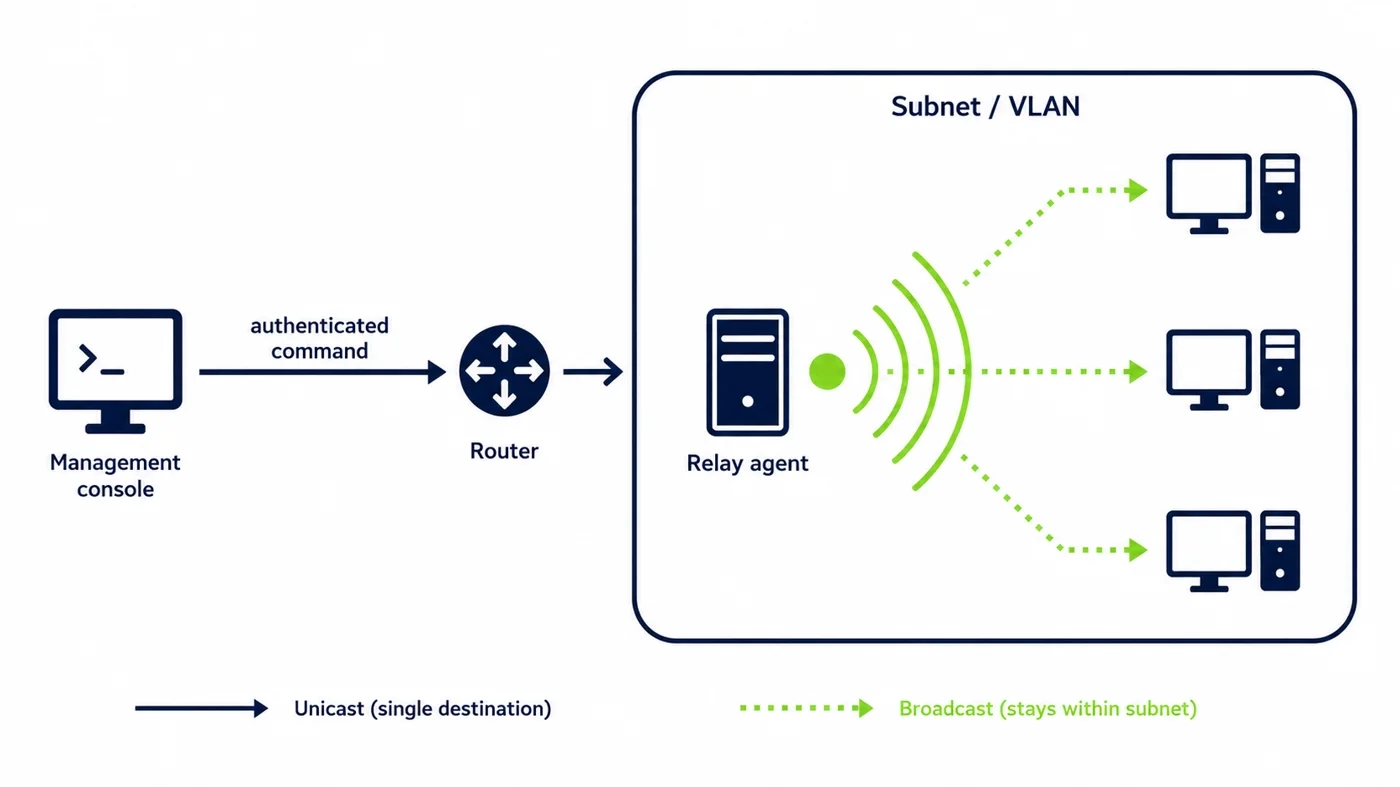
A relay agent is a lightweight piece of software running on a machine that stays reachable inside a subnet. When the central console needs to wake a specific device, it does not try to push a broadcast across the network. It sends a short instruction to the relay agent that already lives in the target segment, and that agent emits the local broadcast the sleeping machine is listening for.
Do that in every segment and the agents form a mesh. Any machine in the estate can be woken from one place, because there is always a local relay close enough to reach it. The wake traffic stays inside each segment, and the only thing that crosses a boundary is a small authenticated command.
How a single relay agent wakes a machine
The sequence is simple by design. The console decides a machine needs to be awake, either on a schedule or because someone asked for it. It looks up which segment that machine lives in and hands the request to the relay agent responsible for that segment. The agent forms the wake packet for the target address and broadcasts it locally, and the machine’s network card, still listening while the rest of the board is off, starts the boot.
Nothing in that path depends on a router forwarding broadcast. The agent is already on the right side of every boundary, so the packet has no boundary to cross. That single change is what turns unreliable cross-subnet wake into something you can schedule against with confidence.
Relay agent, proxy, and router helper are not the same
These terms get used loosely, and the differences matter. A router helper forwards the wake packet’s port from a central source into a remote subnet, which reuses trusted network config but needs an entry per VLAN and careful port scoping. Directed broadcast has the routers forward the broadcast itself, which works but reopens a disabled-by-default risk.
A relay agent is different in kind. It does not ask the network to forward anything. It lives inside the segment and generates the broadcast there, coordinated centrally. That is why an agent mesh scales where the config-based methods strain, and why it keeps working when VLANs get renumbered or new segments appear.
Waking without opening inbound ports
A well-built relay agent reaches out to the management service rather than waiting for the management service to reach in. That outbound model means you do not have to open inbound ports to the internet or poke holes through internal firewalls for wake traffic to arrive.
For a security team this is the difference between a design they can approve and one they will block. The wake broadcast stays local to each segment, the control channel is a short authenticated instruction, and no new inbound path is created for an attacker to probe. Segmentation stays intact, which is the whole point of having it.
The three cross-subnet approaches, compared
The right choice depends on how large and how strict the network is. The table sets the trade-offs side by side.
| Approach | What the network must allow | Security posture | Scales across many sites |
|---|---|---|---|
| Directed broadcast | Routers forward broadcast between subnets | Weak, reopens a disabled feature | Poorly |
| Router helper relay | A helper entry and port per VLAN | Moderate, needs upkeep | With ongoing maintenance |
| Mesh of relay agents | Nothing, wake stays local to each segment | Strong, no inbound ports | Yes, built for it |
How many agents, and where they go
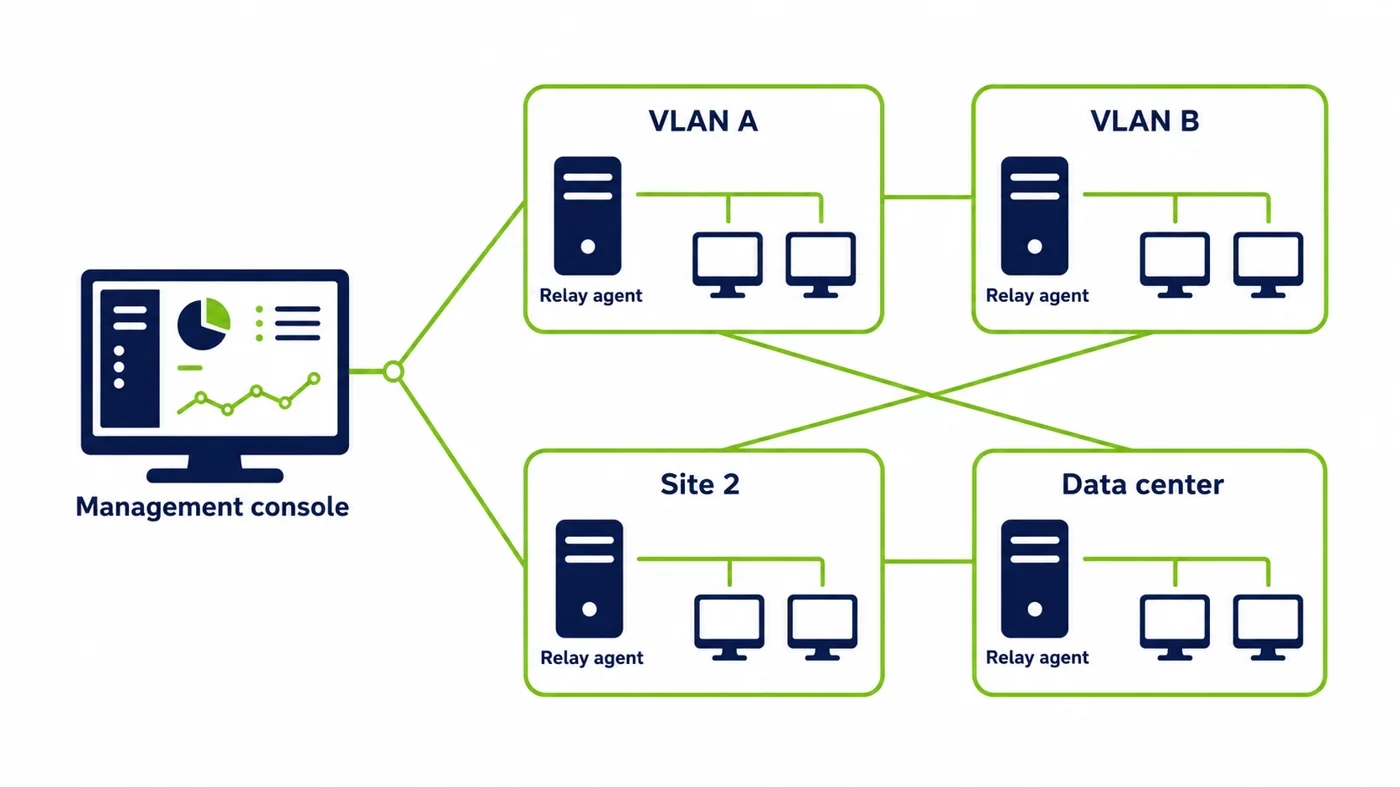
The rule of thumb is one relay per broadcast domain. Every VLAN or subnet that holds machines you want to wake needs at least one always-on device inside it running the agent. A large flat site might need only a handful. A heavily segmented campus needs one per segment, which sounds like a lot until you remember each agent is a small piece of software on a machine that was already going to stay on.
Where uptime matters, add a second agent per critical segment so a single reboot never leaves a subnet unwakeable. The console tracks which agents are healthy and routes each wake to a live one, so redundancy is a matter of placing a spare, not building a cluster.
Waking over VPN and Zero Trust access
Remote work broke the old assumption that the person waking a machine is on the same network as the machine. An engineer at home cannot broadcast onto an office subnet, and a Zero Trust access model deliberately refuses to treat them as if they were local. A relay agent bridges that gap cleanly.
Because the agent lives inside the office segment and the remote request only has to reach the central service, waking a machine from home becomes a request through the same access layer everything else uses. No split tunnel to the broadcast domain, no exception carved into the Zero Trust policy, just an authenticated instruction that ends in a local wake.
The security posture of an agent mesh
Wake-on-LAN has a reputation for being a security liability, and with the broadcast-forwarding methods that reputation is earned. An agent mesh changes the shape of the risk. There is no forwarded broadcast to abuse, no inbound port opened, and the control traffic is authenticated. Access to the wake function can be tied to the same identity and role controls that govern the rest of IT operations.
That last point matters for audit. When waking a machine is an authenticated action with a record of who did it and when, it stops being a loose broadcast anyone on the segment could send and becomes a governed operation. That is the version a security review signs off on.
Why relay setups still fail, and how to avoid it
Even a good design can disappoint if the endpoints are not ready. The most common failure has nothing to do with the mesh. It is a network card that stopped listening for the wake packet because a firmware update, a new hardware model, or a fast-startup setting quietly switched it off. The relay fires correctly and nothing happens.
The other failure is placing no live agent in a segment, so a whole subnet is unreachable while everyone assumes it is covered. Both are avoidable. A managed platform holds the endpoint listening state in place and reports which segments have a healthy agent, so the gaps are visible before a maintenance window exposes them.
Confirming the machine actually woke
Sending a packet is not the same as knowing a machine is up. A design you can rely on closes the loop. After the relay fires, the platform checks whether the target came back rather than assuming the broadcast was enough, and it retries or flags the exception when it did not.
That confirmation is what makes a schedule trustworthy. When the system knows the difference between a packet sent and a machine awake, a fleet can be brought up ahead of a patch window with the assurance that the ones that failed are surfaced, not silently missed. PowerPlug builds this into its Wake-Up technology so a wake is a confirmed outcome, not a hopeful broadcast.
What it delivers day to day
The payoff shows up in three places. Patch and update cycles complete because the machines are reliably awake for them, so compliance stops depending on whether users left their PCs on. Remote support gets faster because an engineer can bring any endpoint back without walking a corridor or phoning a user. And the energy line moves, because machines can finally be powered down overnight without the fear that they will not come back.
That last one is where the mesh pays for itself. Reliable wake is the piece that lets an organization shut idle machines down every night and still meet every maintenance window, which turns overnight idle time into a measurable saving. The platform that coordinates the mesh is described on the platform overview, and it sits at the center of PowerPlug’s enterprise Wake-on-LAN solution. The idle-PC energy that a managed shutdown reclaims is the same waste the US ENERGY STAR program has documented for years.
What deploying the mesh actually involves
A mesh sounds like infrastructure, but the rollout is lighter than it appears. You start by mapping the broadcast domains, the VLANs and subnets that hold machines you want to wake, because that map decides where the agents go. Most organizations already have this from their network documentation, and the gaps it exposes are useful in their own right.
Then you place an agent on a machine that already stays on in each domain, point the agents at the central service, and confirm that a test wake reaches a real endpoint in every segment. There is no re-cabling and no router surgery, which is precisely why the network team tends to prefer this route. From there it is a matter of adding the schedules and access rules that decide who can wake what and when.
The early failures a pilot surfaces are almost always endpoints that were never set to keep listening, not the mesh itself. Fixing those settings once, and holding them in place, is what turns a promising pilot into a fleet you can schedule against every night.
Where a relay mesh pays off first
The organizations that need this most are the ones with the most segments and the least tolerance for a missed machine. A hospital keeps clinical, administrative, and lab networks deliberately apart, and every one of them has machines that must be reachable for patching without loosening the isolation. A university runs faculties, halls, and labs on their own VLANs. A national service has branches in different cities behind one small operations team.
In each case the estate is large, the segmentation is strict, and the maintenance windows are fixed. That is exactly the combination where the broadcast-forwarding methods buckle and where a mesh of relay agents earns its place. Because each segment has its own local relay, the size of the network stops being the obstacle, and the same single action wakes fifty machines on one floor or five thousand across a campus without asking the network to give anything up.
The number that makes the case
The reason to build the mesh at all comes down to arithmetic that is hard to argue with. Put a modest figure on the overnight draw of a single idle desktop, multiply it by the size of the fleet and the number of nights those machines sit unused, and the annual waste climbs into six-figure territory long before anyone counts weekends. None of it does a minute of useful work.
Reliable cross-segment wake is what lets an organization actually claim that saving rather than leaving it on a slide. The machines can be off every night, the patch cycle still completes because the mesh brings them back, and an on-call engineer can still reach any single device in seconds. The cost comes down with no service reduced and no window missed, which is a rare thing to be able to promise. The hard part was never powering the machines down. It was trusting that they would wake, and a coordinated relay mesh is what makes that trust safe to rely on.
Frequently asked questions
Does a relay agent need a machine that stays on in every subnet?
Yes, each segment needs at least one always-on device running the agent so there is a local presence to emit the wake broadcast. In practice that is a small piece of software on a machine that was going to stay on anyway, and you add a second in critical segments for redundancy.
Do I need to change router or firewall rules for mesh wake?
No. The whole point of the agent mesh is that the wake broadcast stays inside each segment, so there are no directed-broadcast or helper entries to add and no inbound ports to open. The only cross-boundary traffic is a short authenticated control instruction.
How many relay agents do I need per site?
One per broadcast domain is the baseline, meaning one per VLAN or subnet that holds machines you want to wake. A flat site may need only a few, a segmented campus needs one per segment, and critical segments get a second agent so a single reboot never leaves them unreachable.
Does mesh wake work over VPN or Zero Trust access?
Yes, and cleanly. Because the agent lives inside the target segment, a remote request only has to reach the central service, not broadcast onto the office subnet. Waking a machine from home becomes an authenticated request through the same access layer as everything else, with no exception carved into the Zero Trust policy.
Is relay-agent Wake-on-LAN secure?
It is far safer than the broadcast-forwarding methods. There is no forwarded broadcast to abuse and no inbound port opened, the control channel is authenticated, and access can be tied to the same identity and role controls as the rest of IT operations, with a record of who woke what and when.
See how much your organization could save
Tell us how many PCs you run and we will show you the realistic energy and cost savings, along with the payback period.
Talk to us